

Revolutionize the energy economy with advanced lithium-ion battery technology—lower costs, reduce heat, and accelerate sustainable development.
 Explore all product lines
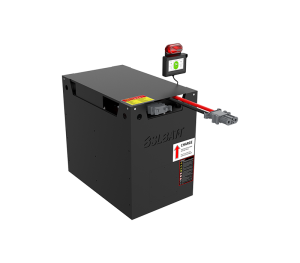
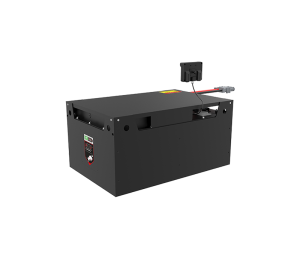
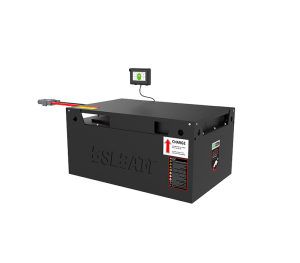
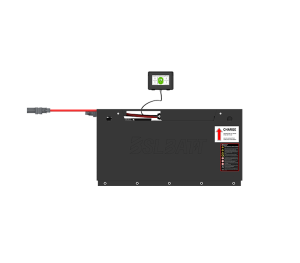






- Specialty Forklift Manufacturers and BSLBATT Lithium Battery Solutions
- The first lithium forklift battery that is UL 2580 certified and ISO9001 certified in the industry is BSLBATT® Battery – Industrial
- Automated Lithium Battery Assembly Line | BSLBATT Smart Factory
- Time to Retire Lead-Acid: Why Your Warehouse Needs Lithium-Ion Power
- Lithium Forklift Battery Maintenance Guide 2026
- Industrial Lithium Batteries: Initial Price vs. Long-Term Costs
Port Machinery
Types of Port Forklifts: A Guide to Port Material Handling Equipment
Table of contents

- What Makes Port Forklifts Different?
- Main Types of Port Forklifts
- 1. Heavy-Duty Forklifts
- 2. Electric Port Forklifts
- 3. Container Forklifts
- 4. Empty Container Handlers
- 5. Reach Stackers Forklift
- 6. Side Loaders Forklift
- Port Forklift Types Compared
- Which Port Forklifts Are Suitable for Lithium Battery Power?
- How Port Forklift Type Affects Battery Requirements
- Why Equipment Type Matters When Choosing a Port Forklift Battery
- How BSLBATT Supports Port Forklift Electrification
- How to Choose the Right Port Forklift for Your Operation
- Step 1: Define the load
- Step 2: Define the operating environment
- Step 3: Define the duty cycle
- Step 4: Identify the equipment type
- Step 5: Evaluate the power system
- Step 6: Match the battery to the machine
- Frequently Asked Questions
- What are the main types of port forklifts?
- What type of forklift is used for container handling?
- Are electric forklifts suitable for port operations?
- Are reach stackers considered forklifts?
- What is the difference between a container forklift and a regular forklift?
- Can lithium batteries be used in port forklifts?
- What should I consider when choosing a lithium battery for a port forklift?
- Conclusion
Walk a container terminal from the quay wall to the gate and you’ll pass half a dozen different machines lifting, stacking and moving cargo — and most of them are not the forklift a warehouse manager would recognize. The main types of port forklifts and related port material handling equipment are heavy-duty forklifts, electric forklifts, container forklifts, empty container handlers, reach stackers and side loaders, each built for a specific job in the cargo flow between vessel, yard, warehouse and truck.
“Port forklift” is a convenient term, but in industry usage it covers a fairly wide band of equipment. A conventional forklift — a counterbalance truck lifting a load in front of the machine — does work in ports, usually in its heaviest classes. But reach stackers, empty container handlers and terminal tractors are distinct machine types with their own architectures, and calling them all “forklifts” causes real confusion when you’re specifying equipment or evaluating a powertrain.
This guide separates them properly: what each machine is, where it works in the port, and — because this is what actually drives equipment decisions — what each one demands from its power system. If you’re weighing battery power for any of this equipment, the machine type is where the analysis starts, not the battery catalog.
What Makes Port Forklifts Different?
A forklift that spends its life indoors on polished concrete lives a sheltered existence. Port equipment does not. Several conditions separate port duty from warehouse duty, and each one pushes back on equipment selection:
- Heavy loads. Ports move steel, machinery, project cargo, laden pallets and containers. Load profiles sit near rated capacity far more often than in general warehousing.
- Outdoor and semi-outdoor operation. The same machine may work an exposed quay, a dusty RoRo ramp and a humid transit shed within one shift. Rain, salt air and dust are normal operating conditions, not exceptions.
- Uneven surfaces. Container yards, rail crossings, dock plates and expansion joints impose constant shock and vibration on the machine and everything mounted in it.
- Long operating hours and high utilization. Terminals work nights, weekends and holidays. Equipment that sits idle is equipment the terminal paid for and cannot use.
- Fast turnaround requirements. Vessel schedules set the pace. A truck that drops out mid-operation costs berth time, which is the most expensive idle time in the port.
- Demanding duty cycles. Frequent lifting, constant travel across yards measured in hectares, and repeated acceleration add up to power demands that a duty-cycle analysis, not a nameplate, has to answer.
No single one of these conditions is unique to ports. The combination is. That’s why power system selection in a port is usually a judgment across load, duty cycle, operating hours, charging opportunities, environmental conditions and equipment design — not a lookup by truck model.
Main Types of Port Forklifts
1. Heavy-Duty Forklifts
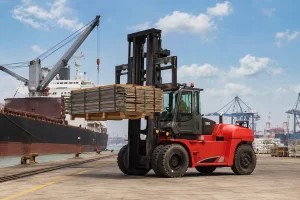
A heavy-duty forklift is a counterbalance forklift built in the upper load classes — the kind of machine that handles steel coils, machinery, project cargo and heavy unitized loads rather than retail pallets. In ports, these trucks work the general cargo quay, break-bulk sheds, RoRo decks and the interface between crane-hook cargo and ground transport.
The difference from a warehouse counterbalance truck is mostly degree, but the degree changes everything: heavier average loads, longer travel distances, more hours per day, and exposure to weather. Structurally these machines carry more counterweight, run larger hydraulic systems and are built to take mechanical punishment.
From a powertrain perspective, the important shift is continuous output. A heavy-duty port forklift spends much of its shift drawing real current — travel motors, lift hydraulics and steering simultaneously — often in warm conditions. Heavy-duty applications often require a battery system designed around the actual duty cycle rather than simply choosing a battery based on nominal capacity. A pack that looks adequate on an Ah rating can still current-limit under sustained multi-function loads, which shows up on the truck as derated performance at the worst moment.
2. Electric Port Forklifts
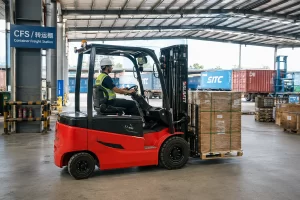
An electric forklift is any forklift driven by an electric powertrain from an onboard battery rather than a diesel or LPG engine. In ports, electric forklifts have traditionally dominated the indoor end of the operation — transit sheds, container freight stations, bonded warehouses — and they are appearing increasingly in outdoor roles as battery technology and charging infrastructure improve.
The basic trade against internal combustion is straightforward: electric drivetrains deliver high torque from zero rpm, produce no local emissions, and are quieter — which matters in ship holds and enclosed working areas. Combustion engines historically won on refueling speed and energy density in the heaviest outdoor classes.
Electric forklifts can be suitable for specific port and terminal applications, but suitability depends on load, duty cycle, operating environment, charging infrastructure and equipment configuration. The largest powertrain consideration in an electric port forklift is not whether the battery can move the truck — it can — but whether the battery system can sustain the terminal’s operating schedule: enough energy between realistic charging opportunities, enough power under peak load, and a battery engineered for outdoor exposure.
3. Container Forklifts
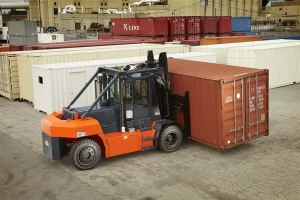
A container forklift — often called a laden container forklift in its heaviest form — is a purpose-built machine that lifts and carries shipping containers using a spreader or container-handling attachment instead of forks. Unlike a general-purpose forklift, it is designed around the container’s geometry and mass distribution, with the attachment overhead and the machine’s stability engineered for suspended loads.
Container forklifts are used for container handling in yards, rail terminals, inland depots and smaller ports where full gantry crane infrastructure doesn’t exist or isn’t justified — moving boxes between stacks, trucks and rail cars.
Because a laden container is a large, heavy, swinging load, these machines demand exceptional load stability, mast rigidity and precise hydraulics, and the duty cycle is demanding: repeated lifts, constant repositioning, long working hours. From a power standpoint, container handling concentrates demand into heavy lift events and sustained travel between stack positions, which places a premium on a powertrain that holds performance under high load rather than one that merely meets a rated figure.
4. Empty Container Handlers
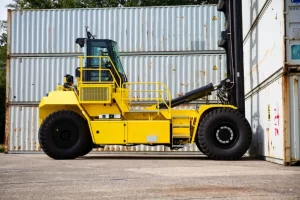
An empty container handler is a specialized machine with an overhead boom and telescopic spreader that lifts, stacks and moves empty (unladen) shipping containers. Empties are light relative to laden boxes, but they stack high — and stacking empties eight or nine high is precisely the job this equipment exists to do.
This is specialized container-handling equipment rather than a conventional forklift, and the distinction matters. The boom architecture, the elevated center of gravity when a container is aloft, and the constant cycle of lift-travel-stack-retrieve have no real equivalent in counterbalance forklift work.
Empty container handling is also one of the more interesting cases for electrification in a port. Because the loads are light, the energy per operating hour is lower than laden handling, while the machine still runs continuous multi-shift cycles. That combination — moderate energy draw, high machine utilization, repetitive duty — shapes what a power system has to deliver: reliability and duty-cycle endurance more than raw peak power.
5. Reach Stackers Forklift
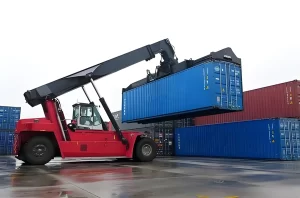
A reach stacker forklift is a specialized container-handling machine that lifts containers with a hydraulic boom and telescopic spreader, and — this is its defining capability — can reach over a row of containers to stack or retrieve a box one or two rows deep. Reach stackers move containers between trucks, rail cars and yard stacks, and they dominate in small and medium terminals and intermodal rail yards where the throughput doesn’t justify gantry cranes.
Reach stackers are specialized container-handling machines rather than conventional forklifts. The boom, the outreach geometry and the counterweight design put them in a different engineering category, and the power demands follow: the hydraulic system works hard through every lift-and-reach cycle, the machine travels constantly with a load at the boom’s end, and the duty cycle is heavy by any measure.
As ports explore lower-emission equipment, battery-electric or hybrid powertrains may be considered for certain applications, but the appropriate solution depends heavily on machine configuration and duty cycle. A reach stacker’s powertrain has to be evaluated on its own terms — energy per cycle, hydraulic peak demand, thermal load, machine architecture — not by scaling up a forklift battery calculation.
6. Side Loaders Forklift
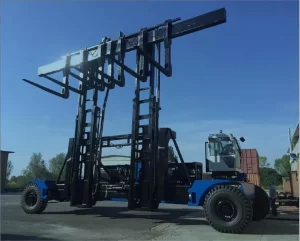
A side loader forklift (or sidelift truck) carries its load along the machine’s longitudinal axis instead of in front of it. Forks or a lifting platform mount on the side, so the truck travels down an aisle in the same direction it handles the load.
In ports and adjacent industrial operations, side loaders are the machine of record for long cargo — steel sections, pipes, timber, poles, structural elements — where a front-loading forklift would be unstable or simply unable to maneuver. Traveling parallel to the load keeps the machine narrow relative to what it carries, which matters in congested yard areas and break-bulk sheds.
For the power system, side loading changes the packaging problem. The battery compartment runs lengthwise with the machine, and the load’s weight distribution shifts side-to-side during handling rather than front-to-back. That places different requirements on battery placement, machine integration and the structural mounting of the pack than a conventional counterbalance installation.
Port Forklift Types Compared
| Equipment Type | Typical Application | Main Operating Characteristic | Typical Power Considerations |
|---|---|---|---|
| Heavy-duty forklift | General cargo, break-bulk, RoRo, heavy unitized loads | High continuous power demand, outdoor travel, multi-shift duty | Capacity matched to duty cycle, sustained discharge capability, thermal performance |
| Electric forklift | Transit sheds, CFS, warehouses, mixed indoor/outdoor | Battery-powered drivetrain, zero local emissions | Charging strategy and infrastructure, energy between charging windows, environmental protection |
| Container forklift | Container yards, depots, rail terminals without gantry cranes | Overhead spreader handling laden containers | High-load performance, stability under suspended load, sustained hydraulic demand |
| Empty container handler | Stacking and moving empty containers | High stacking, repetitive lift-travel-stack cycles | Duty cycle endurance, reliability, moderate energy per cycle |
| Reach stacker | Small/medium terminals, intermodal yards | Boom outreach over rows, heavy container handling | High peak power, powertrain and thermal requirements, machine architecture |
| Side loader | Long cargo — steel, pipes, timber | Loads carried along the machine’s axis | Battery packaging and machine integration, side-load weight distribution |
Which Port Forklifts Are Suitable for Lithium Battery Power?
The honest answer is machine-specific, not fleet-wide. Lithium batteries — practically always LiFePO4 chemistry in industrial vehicles — are well established in certain classes of port equipment and still an engineering conversation in others.
Heavy-duty forklifts are workable ground for lithium, with the caveats that matter in any heavy application: load profile and duty cycle determine required capacity; peak power demand must be checked against the battery’s continuous and burst discharge capability; sustained multi-shift work makes thermal management a first-order requirement, not an afterthought; and the charging strategy — where trucks actually pause, and for how long — sets the energy budget the battery has to cover.
Electric port forklifts are the natural fit. A battery-electric truck is already engineered around its battery, so lithium becomes a question of specification rather than feasibility: matching voltage and capacity to operating hours, fitting the battery compartment, and aligning the charging schedule with the terminal’s rhythm. This is where lithium’s opportunity-charging behavior changes the operating model most directly.
Container handling equipment — container forklifts and empty container handlers — is a legitimate but demanding case. High power demand, long operating periods, and outdoor exposure raise the bar on battery packaging, thermal management and safety systems. Empty container handlers, with their lighter loads and repetitive cycles, are generally the more straightforward of the two.
Reach stackers sit at the demanding end. The power requirements and machine structure are more complex than a forklift’s, and a reach stacker battery system should not be approached with ordinary forklift battery logic — the energy per operating cycle, hydraulic peak loads and thermal profile need their own analysis, and the machine’s own architecture constrains what can be packaged into it.
For a deeper look at battery selection, voltage, capacity, charging, safety and total cost of ownership, continue to BSLBATT’s main guide: Lithium Battery for Port Forklifts.
How Port Forklift Type Affects Battery Requirements
Every equipment type maps to a duty cycle, and the duty cycle maps to battery requirements. That chain is what connects equipment selection to powertrain selection:
| Equipment | Key Operating Factor | Battery Consideration |
|---|---|---|
| Heavy-duty forklift | Heavy loads | Power and capacity |
| Electric forklift | Regular charging cycles | Charging strategy and capacity |
| Container forklift | Container handling | High-load performance |
| Empty container handler | Repetitive container movement | Duty cycle and reliability |
| Reach stacker | Heavy container handling | Powertrain and thermal requirements |
| Side loader | Side-loading operation | Battery packaging and machine integration |
Two patterns are worth reading out of the table. First, capacity is rarely the whole answer — a reach stacker and a heavy-duty forklift may have similar daily energy totals and completely different peak-power and thermal profiles. Second, the machine’s physical architecture constrains the battery as much as its energy demands do: a side loader’s compartment, a counterbalance truck’s ballast role, and a reach stacker’s structural layout each dictate different packaging solutions.
Why Equipment Type Matters When Choosing a Port Forklift Battery
The practical failure mode in battery selection is treating “port forklift battery” as one product category. It isn’t. The same port can run a 5-ton electric counterbalance truck on one battery specification and an empty container handler on something with entirely different packaging, power delivery and integration requirements.
When evaluating a battery for any port machine, the checklist that has to be answered before price: voltage, capacity, peak and continuous power, duty cycle, operating temperature, battery compartment dimensions, charging infrastructure, communication with the vehicle, BMS capability, safety systems and maintenance requirements. Which of these dominates depends on the equipment — which is the point.
That full checklist, and how to work through it, is covered in BSLBATT’s guide on the lithium battery for port forklifts. This article’s job is the step before it: knowing which machine you’re actually specifying for.
How BSLBATT Supports Port Forklift Electrification
BSLBATT focuses on lithium battery systems for industrial vehicles and material handling applications. Founded in 2011 and headquartered in Guangdong, China, the company builds LiFePO4 battery systems for forklifts and other industrial equipment, with batteries deployed in more than 150,000 units across 118+ countries.
Several aspects of how those systems are built are relevant when the application is port equipment:
- LiFePO4 chemistry with a battery management system monitoring cell-level voltage and temperature, with balancing, protection functions and CAN communication with the vehicle.
- Sealed construction with IP65-rated protection, for machines that work outdoors through rain, dust and washdown.
- A built-in fire suppression system as standard, alongside the BMS protection layers, for battery-level fire safety.
- A smart power distribution unit that consolidates BMS, charging and DC modules, with a modular service design intended to simplify maintenance and parts replacement.
- Cloud-based remote monitoring, so battery status across a fleet is visible without walking the yard.
- Operating temperature engineering, with charge and discharge ranges and low-temperature options suited to outdoor duty.
- An external display on the battery for state of charge and fault visibility in the cab.
- Matching chargers and battery customization, so the battery, charger and machine configuration are engineered as one system.
None of that makes the equipment decision for you. Battery requirements vary significantly between port equipment types, and the right configuration depends on the machine, duty cycle and operating environment. BSLBATT can evaluate battery requirements based on equipment configuration, duty cycle and operating conditions — which is the correct starting point for any port application.
How to Choose the Right Port Forklift for Your Operation
Equipment selection in a port usually works better as a sequence than as a catalog search:
Step 1: Define the load
What is actually being moved — palletized cargo, break-bulk, long steel, laden or empty containers? Load type and weight eliminate most of the equipment list immediately.
Step 2: Define the operating environment
Indoor shed, outdoor quay, container yard, RoRo deck, or a mix? Exposure to rain, salt air, dust and uneven surfaces sets the durability and protection class the equipment needs.
Step 3: Define the duty cycle
How many hours per day does the machine run? Is operation continuous across shifts, or does it have natural pauses? Utilization is what separates the machines that need maximum availability from the ones that can share charging windows.
Step 4: Identify the equipment type
With load, environment and duty defined, the equipment choice — heavy-duty forklift, electric forklift, container forklift, empty container handler, reach stacker, side loader — usually narrows to one or two realistic candidates.
Step 5: Evaluate the power system
Against the chosen machine, work the power questions: battery voltage, capacity, peak power, charging approach, thermal management, safety, BMS, battery dimensions. These are machine-dependent, not generic.
Step 6: Match the battery to the machine
The last step is the one most often skipped: the battery is not a standalone component selected from a price list — it is part of the vehicle’s power system, and it has to fit the machine’s compartment, weight distribution, communication architecture and duty cycle as a single engineered unit.
Frequently Asked Questions
What are the main types of port forklifts?
The main types are heavy-duty forklifts, electric forklifts, container forklifts, empty container handlers, reach stackers and side loaders. Of these, reach stackers and empty container handlers are specialized container-handling machines rather than conventional forklifts, but they’re often grouped under the broader “port forklift” label.
What type of forklift is used for container handling?
Container handling uses container forklifts (with overhead spreaders), reach stackers and empty container handlers, depending on whether containers are laden or empty and how deep the stacking needs to go. Empty container handlers handle empties; reach stackers and laden container forklifts handle loaded boxes.
Are electric forklifts suitable for port operations?
They can be, depending on the application. Electric forklifts are well established in indoor port facilities and are expanding into outdoor roles. Suitability depends on load, duty cycle, operating environment, charging infrastructure and equipment configuration — the heaviest outdoor classes remain the most demanding cases.
Are reach stackers considered forklifts?
No. Reach stackers are specialized container-handling machines with a hydraulic boom and telescopic spreader. They lift, reach and stack containers in ways a conventional forklift cannot, and their powertrain requirements are evaluated on different terms than a forklift’s.
What is the difference between a container forklift and a regular forklift?
A container forklift lifts shipping containers with an overhead spreader or container attachment, and its structure, stability systems and hydraulics are engineered around suspended container loads. A regular counterbalance forklift handles palletized or unitized loads on forks in front of the machine.
Can lithium batteries be used in port forklifts?
Yes, in the right applications. LiFePO4 lithium batteries are established in electric forklifts working port environments and are being applied in heavier port equipment where duty cycle, charging opportunities and machine design support them. Suitability is machine-specific — an electric shed forklift and a reach stacker are entirely different battery cases.
What should I consider when choosing a lithium battery for a port forklift?
Start from the machine and its duty: voltage and capacity, peak and continuous power, battery compartment dimensions, operating temperature range, charging infrastructure and windows, BMS capability and vehicle communication, safety systems, and maintenance requirements. BSLBATT’s guide on lithium battery for port forklifts covers this in depth.
Conclusion
There is no single “port forklift” that fits every job in a terminal. Heavy-duty forklifts, electric forklifts, container forklifts, empty container handlers, reach stackers and side loaders each work different cargo, in different places, on different schedules — and therefore place different demands on their power systems. Load, duty cycle, environment and machine architecture determine what the battery has to deliver, not the other way around.
That’s the sequence this guide has followed: equipment type first, duty cycle second, power system third. If you’re evaluating lithium battery power for port equipment, the next step is the full battery-side analysis — voltage, capacity, charging strategy, safety and total cost of ownership — which is covered in BSLBATT’s complete guide: Lithium Battery for Port Forklifts.
Related Product Recommendations
-
38.4V 690AH
36 Volt Forklift Battery 690Ah Lithium-ion Solution for Reach Trucks & Class I Fleets | BSLBATT
Learn More -
83.2V 1380AH
80V Forklift Battery 1380Ah for Heavy-Duty Use | BSLBATT
Learn More -
83.2V 612AH
83.2V Forklift Truck Batteries for Sale 612Ah Lithium | BSLBATT
Learn More -
51.2V 840AH
Forklift Trucks Lithium Ion Battery for Custom Shapes | BSLBATT
Learn More -
72V 410AH
Industrial Batteries for Forklifts Custom Shapes | BSLBATT
Learn More