Revolutionize the energy economy with advanced lithium-ion battery technology—lower costs, reduce heat, and accelerate sustainable development.
 Explore all product lines






- Specialty Forklift Manufacturers and BSLBATT Lithium Battery Solutions
- The first lithium forklift battery that is UL 2580 certified and ISO9001 certified in the industry is BSLBATT® Battery – Industrial
- Automated Lithium Battery Assembly Line | BSLBATT Smart Factory
- Time to Retire Lead-Acid: Why Your Warehouse Needs Lithium-Ion Power
- Lithium Forklift Battery Maintenance Guide 2026
- Industrial Lithium Batteries: Initial Price vs. Long-Term Costs
Port Machinery
Port Forklift vs. Warehouse Forklift: What’s the Difference?
Table of contents
- Port Forklift vs. Warehouse Forklift at a Glance
- What Is a Port Forklift?
- What Is a Warehouse Forklift?
- Key Differences Between Port and Warehouse Forklifts
- Operating Environment
- Load and Duty Cycle
- Size and Maneuverability
- Operating Hours and Utilization
- Port Forklift vs. Warehouse Forklift: Battery Requirements
- Can a Warehouse Forklift Be Used in Port Operations?
- Can Lithium Batteries Be Used in Port Forklifts?
- Lithium Battery Considerations for Port vs. Warehouse Applications
- Which Is Better: A Port Forklift or a Warehouse Forklift?
- How BSLBATT Approaches Port Forklift Battery Requirements
- How to Choose the Right Forklift for Your Operation
- Frequently Asked Questions
- What is the difference between a port forklift and a warehouse forklift?
- Can a warehouse forklift be used at a port?
- Are port forklifts usually heavier than warehouse forklifts?
- What type of forklift is best for container yards?
- Do port forklifts need different batteries?
- Can lithium batteries power electric port forklifts?
- What should I consider when choosing a lithium battery for a port forklift?
- Conclusion
A port forklift and a warehouse forklift can look almost identical from the outside, and that is where the buying mistakes start. When you compare a port forklift vs warehouse forklift, the differences that actually matter are rarely visible on a spec sheet: the operating environment, the duty cycle, the load profile, the equipment configuration, and what the power system has to survive over years of service.
Warehouse forklifts usually run controlled shifts on smooth floors with predictable loads. Port forklifts work outdoor yards, exposed quays, container terminals and break-bulk areas, often around the clock, often in weather, often at the upper end of the machine’s rated capacity. That is the line that separates the two, and the rest of this guide explains where it is, why it matters, and how it shapes the right battery decision.
Port Forklift vs. Warehouse Forklift at a Glance
The table below is a starting point, not a verdict. Any given site breaks the general pattern in its own way.
| Factor | Port Forklift | Warehouse Forklift |
|---|---|---|
| Operating environment | Outdoor, terminal, container yard, break-bulk areas | Mostly indoor, controlled |
| Typical duty | Heavy or demanding material handling | Repetitive warehouse handling |
| Surface conditions | May be uneven, exposed, contaminated | Usually smoother and controlled |
| Load requirements | Can be higher depending on equipment | Usually lighter, application-dependent |
| Operating hours | Can involve long or intensive duty cycles | Often scheduled around warehouse shifts |
| Weather exposure | Possible | Limited |
| Battery considerations | High power, capacity and environmental requirements | Capacity, charging and maneuverability |
| Equipment configuration | Application-specific | More standardized in many applications |
Not every port forklift is heavy-duty. Not every warehouse forklift is small. What changes between the two is the design center of gravity — what the machine was built to do most of the time.
What Is a Port Forklift?
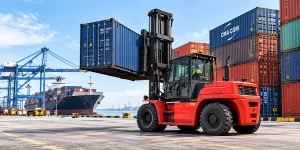
“Port forklift” is a convenient umbrella term, and in industry usage it covers a fairly wide band of equipment. A conventional forklift operating in a port may be a heavy-duty counterbalance truck in the upper load classes, a battery-electric truck working transit sheds, or a specialized container-handling machine. Reach stackers, empty container handlers and terminal tractors are specialized port material handling equipment and should not be lumped under the same label when specifying equipment or sizing a battery.
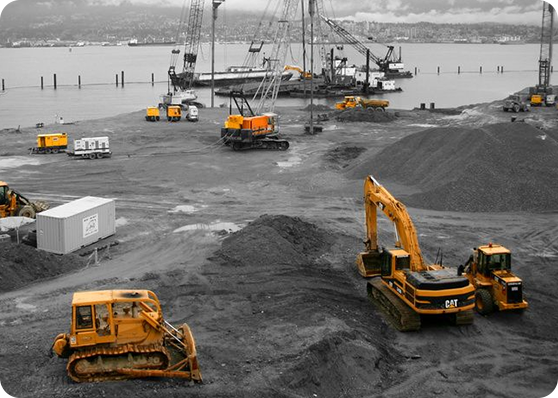
Typical port applications include container yards, cargo terminals, warehouses near the quay, freight handling areas, and the loading and unloading operations between ship, shore and road. Depending on the application, machine class, duty cycle and configuration, the equipment selection — and the power system — looks very different.
What Is a Warehouse Forklift?
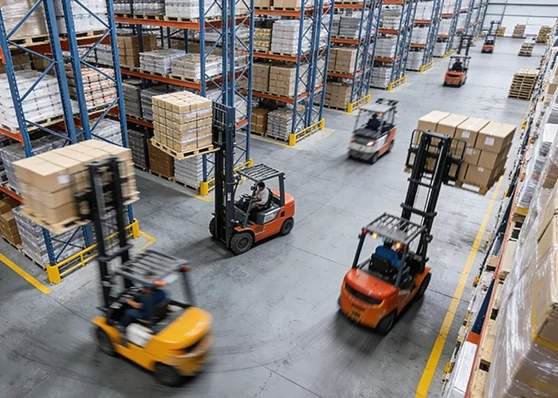
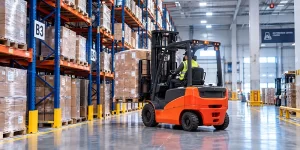
A warehouse forklift is a forklift optimized for the work that happens inside a building: distribution centers, warehouses, manufacturing facilities, indoor storage, pallet handling, loading docks. The design priorities reflect the job: maneuverability in narrow aisles, precise load handling at height, repetitive operation cycle after cycle, space efficiency, and predictable behavior in a controlled environment.
Warehouse forklifts range from compact electric pallet trucks through high-rack turret trucks to heavy counterbalance machines serving industrial storage. Calling them all “small forklifts” is wrong; the application is what makes them warehouse forklifts, not the tonnage.
Key Differences Between Port and Warehouse Forklifts
The four factors below do most of the work when buyers compare a port forklift vs warehouse forklift. Each one pushes equipment and battery selection in a different direction.
Operating Environment
Port equipment works outside. Rain, dust, salt air, mud, temperature swings and uneven ground are normal operating conditions, not exceptions. Warehouse equipment works inside, on smooth floors, with stable temperature and limited weather exposure. The list looks obvious written down, but the consequences are not: enclosures need corrosion protection, electronics need sealing, batteries need higher IP ratings, and cooling air may carry contaminants the machine has to filter. None of that matters much in a typical warehouse.
Load and Duty Cycle
Port work concentrates load on the upper end of the machine’s rating more often than warehouse work does — steel coils, machinery, laden containers, dense project cargo — and it does so under multi-function demand (travel, lift, hydraulics, steering) that pulls current continuously. Warehouse work is more often repetitive pallet handling at moderate loads, with shorter travel distances and more predictable cycle times. Both produce demanding duty cycles, but the shape of that demand is different. Duty cycle matters more than the equipment label alone, and that point will come back when the battery is sized.
Size and Maneuverability
Port equipment usually has room to work. Container yards, quay aprons and break-bulk sheds are measured in hectares, not meters, and a port forklift can be a long, heavy, stability-optimized machine. Warehouse equipment runs in narrow aisles, tight turning radii, racking systems and congested dock areas. The same engineering parameter — wheelbase, mast height, counterweight distribution, battery compartment shape — gets optimized for very different geometry. A machine that thrives in a yard may simply not fit in a rack aisle, and a warehouse turret truck that excels at high-rack work has no business in a container stack.
Operating Hours and Utilization
A single-shift warehouse running 8 hours a day and a three-shift port running 24/7 place completely different demands on a battery. A port operation may charge opportunistically between vessel calls; a warehouse may charge on a fixed schedule tied to shift changes. None of this is visible from the truck model. Operating hours and utilization determine the energy budget the battery has to cover, and the wrong answer here is the most common reason fleets end up with under-sized or over-sized packs. Don’t pick a battery by where the truck works; pick it by how the truck works.
Port Forklift vs. Warehouse Forklift: Battery Requirements
Duty cycle drives the difference more than geography does. A few points to separate:
Port forklift battery considerations. Higher power demand under sustained load, longer duty cycles, larger battery capacity in many cases, peak current during multi-function work, thermal management for hot duty or warm climates, IP protection for outdoor exposure, operating temperature range for cold and hot seasons, battery compartment packaging for heavier packs, charging infrastructure sized for fast turnaround, and BMS communication that integrates with the vehicle’s existing systems.
Warehouse forklift battery considerations. Battery capacity matched to shift requirements, a charging schedule that fits shift planning (including opportunity charging in some applications), battery dimensions that match the compartment, charging infrastructure sized to the building’s electrical capacity, and indoor operating requirements around emissions, ventilation and noise.
The right battery is determined by the machine and duty cycle, not simply by whether the forklift operates in a port or warehouse. Two port operations can demand very different battery systems, and so can two warehouses. The label tells you where the truck parks. The duty cycle tells you what the battery has to do.
For a deeper look at how voltage, capacity, charging, safety and total cost of ownership interact for these machines, see BSLBATT’s main guide.
Can a Warehouse Forklift Be Used in Port Operations?
Sometimes, and only when the application allows it. A warehouse forklift may be suitable for light, controlled, port-adjacent tasks — covered transit sheds, indoor freight stations, small parts depots — where loads are moderate, surfaces are predictable and weather exposure is limited. The moment the work moves onto an exposed yard, a dusty container stack or a wet RoRo ramp, the duty profile changes and a standard warehouse machine is the wrong answer.
The evaluation should cover load, surface, weather exposure, duty cycle, machine rating, safety requirements, battery system and equipment configuration. A warehouse forklift used outside its design envelope tends to fail in the obvious places: corrosion in the chassis, electrical faults in unsealed enclosures, thermal derating in the powertrain, and structural fatigue from surfaces the machine was never built for.
Can Lithium Batteries Be Used in Port Forklifts?
Yes, lithium battery systems can be used for suitable electric port forklift applications, but the battery must be matched to the machine and duty cycle. What that means in practice: voltage aligned with the truck’s electrical architecture; capacity sized to actual operating hours and energy draw; peak and continuous power verified against the worst-case duty cycle; thermal management sized for climate and load; environmental protection matched to the operating site; BMS functionality compatible with the vehicle’s monitoring and shutdown systems; battery dimensions that fit the compartment; and communication protocols that integrate with the truck.
The detailed battery selection framework — including voltage sizing, capacity calculations, BMS evaluation, safety systems, charging infrastructure and TCO analysis — is in the Pillar Page. See Lithium Battery for Port Forklifts for the full discussion.
Lithium Battery Considerations for Port vs. Warehouse Applications
The comparison below is conceptual, not a quote. Specific numbers depend on the machine, the duty cycle and the supplier.
| Battery Factor | Port Application | Warehouse Application |
|---|---|---|
| Duty cycle | Often demanding | Application-dependent |
| Environmental exposure | May be higher | Usually more controlled |
| IP protection | Important in outdoor environments | Depends on application |
| Thermal management | Important for demanding duty | Depends on load and duty |
| Charging strategy | Important for fleet utilization | Important for shift planning |
| Battery capacity | Based on load and duty cycle | Based on shift and usage |
| BMS | Important | Important |
| Battery integration | Machine-specific | Machine-specific |
Two things stand out. First, BMS and battery integration matter in both environments, not just one. Second, the differences are usually about degree, not category — a port battery is typically a more robust version of a warehouse battery in the same chemistry family, with stronger protection, better thermal headroom and more careful integration, rather than a fundamentally different product.
Which Is Better: A Port Forklift or a Warehouse Forklift?
Neither is universally better. The right forklift depends on the operating environment and duty cycle, and a poor fit in either direction wastes capital.
Choose a port-oriented forklift when applicable:
- Outdoor operation is frequent
- Heavy or dense cargo is involved
- The equipment works in container yards, break-bulk areas or on the quay
- Long or demanding duty cycles are expected
- Environmental exposure — weather, dust, salt — is significant
Choose a warehouse forklift when applicable:
- Operation is mainly indoors
- Aisles are narrow and racking is dense
- Maneuverability and precision are priorities
- Loads are relatively standardized
- The environment is climate-controlled and clean
The worst decisions usually come from picking the machine first and then asking what battery will fit, or from treating “port” and “warehouse” as marketing categories that override the actual application. A port forklift that never leaves a covered transit shed is overspec’d. A warehouse forklift sent into a container yard is underspec’d. The job profile settles the question.
How BSLBATT Approaches Port Forklift Battery Requirements
BSLBATT develops lithium battery systems for industrial vehicles and material handling equipment, including the kinds of electric port forklifts and electric industrial trucks that work in port and terminal environments. The capabilities below are relevant to the duty cycle, environmental and integration requirements discussed earlier in this article; specific equipment classes vary in their configuration, and not every feature applies to every model.
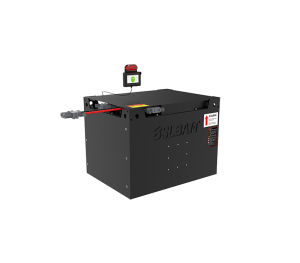
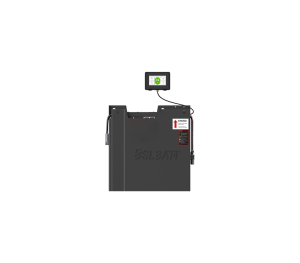
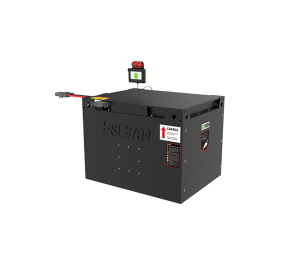
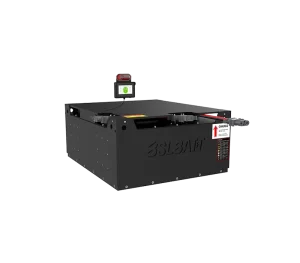
The product family uses LiFePO4 chemistry, the established standard for industrial motive power. Battery management includes a 32-bit BMS with CAN communication for vehicle integration. Mechanical protection is offered at IP65 for harsh outdoor environments, with IP54 as the standard level for many industrial models. A built-in aerosol fire suppression system is included on selected configurations, with activation around 170 °C at the cell level, designed to suppress a thermal event at an early stage. An active thermal management module is available on selected models to reduce operating temperatures under demanding duty. A Smart PDU supports modular service design. GPRS-based cloud monitoring and an external display are available for fleet visibility. Matching chargers and battery customization are offered to fit specific machine configurations.
The way BSLBATT frames the evaluation matters as much as the spec sheet. Rather than promoting a single pack as the answer to all port equipment, BSLBATT works from the machine and duty cycle backward: equipment configuration, operating hours, load profile, charging opportunities and environmental conditions first, then the battery specification. For an operator who already knows the machine and the duty cycle and wants the corresponding battery selection guidance, Lithium Battery for Port Forklifts covers the framework in detail.
How to Choose the Right Forklift for Your Operation
A short checklist that holds up across both port and warehouse buyers:
- Define the load. What is being moved, at what weight, at what frequency, and at what lift height?
- Measure operating hours. Single shift, two shifts, three shifts, peak periods, idle time between tasks.
- Understand the surface and environment. Indoor, outdoor, uneven ground, weather exposure, dust, salt, temperature.
- Determine indoor or outdoor use. This sets the equipment class and the protection level required.
- Evaluate charging opportunities. Where can the truck charge, for how long, how often, and at what power?
- Define battery compartment requirements. Dimensions, weight, counterbalance, ventilation, connector type.
- Check vehicle-battery communication. BMS protocol, CAN integration, telemetry, shutdown signals.
- Consider future operating requirements. Fleet growth, duty cycle changes, electrification targets, regulatory shifts.
Choose the machine first, then match the battery system to the actual duty cycle. Reversing that order is how fleets end up with batteries that look right on a quote and behave wrong on the floor.
Frequently Asked Questions
What is the difference between a port forklift and a warehouse forklift?
A port forklift is designed for outdoor terminal work — container yards, cargo areas, exposed quays — with heavier duty cycles, weather exposure and often higher loads. A warehouse forklift is built for controlled indoor operation — distribution centers, storage facilities, loading docks — with priorities on maneuverability, precision and space efficiency. Operating environment, duty cycle and equipment configuration are what separate them.
Can a warehouse forklift be used at a port?
In light, controlled, port-adjacent applications — covered transit sheds, indoor freight stations, small parts depots — a warehouse forklift may be suitable. For exposed yard work, container handling or wet or dusty environments, a warehouse machine is generally the wrong tool. The evaluation should look at load, surface, weather exposure, duty cycle, machine rating, safety requirements, battery system and equipment configuration.
Are port forklifts usually heavier than warehouse forklifts?
Not always. Some port forklifts operate at high load classes for heavy cargo; others are battery-electric trucks in lighter classes working sheds and freight stations. Some warehouse forklifts are large industrial counterbalance or turret trucks at high tonnages. The label is less important than the equipment class, the load profile and the duty cycle — many forklifts look similar across both worlds, and configuration is what changes.
What type of forklift is best for container yards?
Depends on the operation. Heavy-duty container forklifts handle laden boxes where gantry cranes aren’t available; empty container handlers stack empties; reach stackers serve intermodal yards and smaller terminals; standard heavy-duty forklifts handle general cargo. The best choice depends on container mix, stack height, throughput and machine availability, not a single model recommendation.
Do port forklifts need different batteries?
Often yes, because the duty cycle and environmental exposure are different. Port applications may require higher power delivery under sustained load, larger battery capacity, stronger thermal management, higher IP protection, and integration with fast-turnaround charging. That said, the differences are usually about degree, not category — a robust industrial LiFePO4 system engineered for the duty cycle is the right answer, configured appropriately for the application.
Can lithium batteries power electric port forklifts?
Yes. Lithium battery systems — practically always LiFePO4 in industrial motive power — can power suitable electric port forklifts. The key is matching voltage, capacity, peak and continuous power, thermal management, IP protection, charging strategy, BMS communication and battery dimensions to the specific machine and duty cycle. The detailed selection framework is in the Pillar Page on lithium batteries for port forklifts.
What should I consider when choosing a lithium battery for a port forklift?
Start with the machine and duty cycle: load profile, operating hours, charging opportunities and environmental conditions. Then evaluate battery specifications: voltage, capacity, peak and continuous discharge capability, thermal management, IP protection, BMS features, safety systems, dimensions and weight. Match the charger to the battery and the operation, and evaluate total cost of ownership across the battery’s service life rather than the purchase price alone. The Pillar Page on lithium batteries for port forklifts walks through this in detail.
Conclusion
A port forklift vs warehouse forklift comparison is not about which machine is more capable. It is about which machine matches the work. The two equipment categories are designed around different operating environments, duty cycles and load profiles, and those differences drive the right battery selection just as much as the right equipment selection.
If you are evaluating lithium battery power for an electric port forklift — or trying to understand how voltage, capacity, charging, safety and total cost of ownership apply to your specific operation — continue to BSLBATT’s main guide.
Related Product Recommendations
-

25.6V 100AH
24V Forklift Lithium Battery 100Ah Compact Energy Solution | BSLBATT
Learn More -
83.2V 1380AH
80V Forklift Battery 1380Ah for Heavy-Duty Use | BSLBATT
Learn More -
51.2V 615AH Lithium Forklift Battery
Electric Forklift Batteries for Sale UL Certified 48V 615Ah IP65 Lithium | BSLBATT
Learn More -
96V 920AH
Electric Forklift Battery Price 83.2V 920Ah IP69 | BSLBATT
Learn More -
51.2V 560AH
Lithium Battery for Forklift Massive 48V 560Ah Endurance Pack | BSLBATT
Learn More