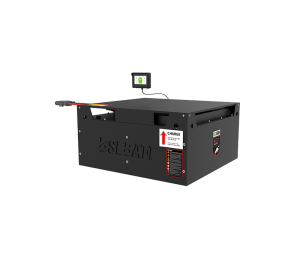
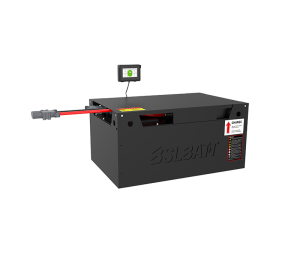
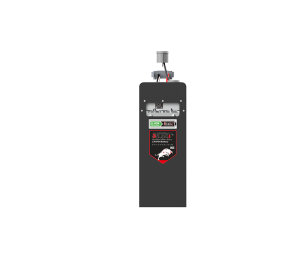
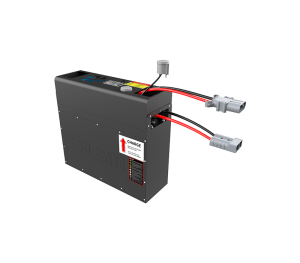
A battery-powered utility vehicle or compact electric tractor can look highly productive on a spec sheet — strong torque, decent amp-hour rating, a battery voltage that matches the drivetrain. But the number that actually determines how much work gets done in a day isn’t voltage or capacity. It’s how many hours the machine is actually available to run.
That availability is shaped by things a spec sheet doesn’t show: how long the battery takes to charge, whether the crew has to stop mid-shift to swap packs, how much of the rated capacity is actually usable under load, and how much time gets absorbed by routine battery maintenance. On a farm, where work is tied to weather windows and daylight hours rather than a fixed shift schedule, these hidden losses matter more than they would in most other industries.
This article isn’t another “lithium is better than lead-acid” argument. It walks through a transparent, step-by-step calculation of how switching from a lead-acid battery to a lithium (LiFePO4) battery can change the productive operating hours of a piece of agricultural machinery — and what that translates to in terms of hectares covered, loads hauled, or rows serviced. The goal is to give agricultural OEMs, fleet operators, dealers, and farm owners a framework they can adapt to their own equipment and duty cycle, not a marketing number to repeat.
Why Battery Efficiency Matters More in Agricultural Operations
Agricultural equipment doesn’t operate on a predictable, year-round schedule. Most farms concentrate the bulk of their annual workload into a handful of critical windows — planting, spraying, harvesting — where weather, daylight, and crop timing leave little room for delay. A charging stop or a battery swap that would be a minor inconvenience in a warehouse becomes a real constraint when a harvest window might only last a few days.
A few characteristics of agricultural operations make battery efficiency disproportionately important:
Long operating days during peak season.Planting and harvest often push equipment close to its full duty-cycle limit, day after day.
Remote or limited charging infrastructure.Fields and orchards frequently don’t have the same electrical infrastructure as a warehouse or distribution center.
Labor shortages.Many operations are already running lean on operators; time spent managing batteries is time not spent running equipment.
High cost of downtime during weather-dependent windows.A rain delay is unavoidable. A charging delay is not — and it stacks on top of weather risk rather than replacing it.
None of this means lead-acid batteries are unusable in agriculture — they’ve powered electric and hybrid agricultural equipment for decades. It means that when evaluating a battery system for a farm application, the relevant question isn’t just “how much energy does it store,” but “how many productive hours does it give back to the operator in a real working day.”
Where Lead-Acid Batteries Can Reduce Productive Working Time
Long Charging Cycles
Flooded lead-acid batteries typically require a full charge cycle of roughly 8 hours, followed by a cooling-down period before the battery can be safely put back into heavy use. In a single-shift operation, this usually isn’t a problem — the battery charges overnight. In an operation that needs the equipment for more than one shift, or that wants flexibility to run later into a harvest day, that charging window becomes a real constraint. This is equipment-specific and depends heavily on charger type, ambient temperature, and how deeply the battery was discharged, so it should be treated as a general pattern rather than a fixed rule for every machine.
Battery Swapping
Some operations address the charging-time problem by keeping spare battery packs on hand and swapping them mid-shift. This solves the immediate downtime issue, but it introduces its own costs:
Operator time to perform the swap safely
Battery handling equipment (hoists, carts, or dedicated swap stations for larger packs)
Capital tied up in spare battery inventory
Safety procedures around acid, weight, and ventilation
Dedicated storage and charging space for spare batteries
For a small operation with one or two vehicles, this overhead may be manageable. For a larger fleet, it starts to look like a parallel logistics operation built entirely around keeping batteries charged.
Usable Capacity and Voltage Drop
A battery’s rated amp-hour capacity is not the same as what an operator can actually use in the field. Lead-acid batteries are generally recommended to stay above roughly 50% depth of discharge to protect cycle life, which effectively halves the usable capacity compared to the nameplate rating. On top of that, voltage sags as the battery discharges and under heavy load, which can reduce torque and performance well before the battery is technically “empty.” The practical result is that the last portion of a lead-acid battery’s charge is often the least reliable portion to work with — exactly when an operator needs consistent power for high-load tasks like plowing or loading.
Maintenance and Unexpected Downtime
Flooded lead-acid batteries require ongoing maintenance to perform as expected: periodic watering to keep electrolyte levels correct, terminal inspection and cleaning to prevent corrosion, and occasional equalization charging to keep individual cells balanced. Skipping these tasks doesn’t just void a warranty in the abstract — it tends to show up later as reduced runtime, unexpected failures, or a shortened battery life, all of which create downtime at unpredictable times rather than on a planned schedule.
A Practical Daily Efficiency Calculation: Lead-Acid vs. Lithium
The following example is illustrative.Actual results depend on equipment load, battery capacity, charging power, operating conditions, temperature, and work cycle. Use it as a template to run your own numbers, not as a guaranteed outcome.
Example equipment:a compact electric agricultural utility vehicle running a planned 10-hour operating day during a busy planting or harvest period.
Factor
Lead-Acid Battery
Lithium Battery
Usable operating time before recharge
≈4 hours (limited to ~50% DOD to protect battery life)
≈8–9 hours (usable to 80–90% DOD)
Charging time for a full recharge
≈8 hours, plus a cooling period
1–2 hours for a full charge; well suited to shorter top-ups
Opportunity charging
Not generally recommended — partial charging can accelerate sulfation and shorten life
Well suited to short top-ups during natural breaks
Battery swapping requirement
Often needed to complete a full day without an overnight recharge
Potential increase in productive equipment availability:
(9.7 − 8.3) ÷ 8.3 ≈17%
AGRICULTURAL BATTERY EFFICIENCY CALCULATOR
Calculate Your Productive Time: Lead-Acid vs. Lithium
Compare how charging downtime and routine battery maintenance can affect productive operating hours and estimated output in agricultural equipment.
Operating Schedule
hrs
days
Lead-Acid Battery
hrs/day
min/week
Lithium Battery
hrs/day
min/week
Estimated Productive Time
LEAD-ACID
—
LITHIUM
—
ESTIMATED AVAILABILITY GAIN
—
Based on the figures entered above.
Estimate Additional Output
Additional output per day
—
Additional output per week
—
Additional output per year*
—
Run this with your own numbers.The calculator above uses the same formula as this example — swap in your shift length, downtime, and maintenance figures to see what the gap looks like for your specific equipment and duty cycle.
That figure is specific to this example scenario — a single-shift, 10-hour operating day with one mid-shift battery swap under lead-acid. A multi-shift operation that currently relies on spare battery packs, or one running in cold conditions that further limit lead-acid performance, could see a larger gap. A short, light-duty operation that never approaches the battery’s usable capacity in a day might see a smaller one. The value of walking through the calculation is that it makes those variables visible instead of hiding them behind a single marketing percentage.
What Does One Additional Productive Hour Mean on a Farm?
An extra 1.4 hours of equipment availability per day is only useful if it converts into more completed work. Two example scenarios illustrate how that translates for different types of agricultural machinery. Both are hypothetical and meant to be adapted to actual cycle times and loads.
Scenario 1: Agricultural Transport Vehicle
Assume a transport vehicle completes one round trip — loading, hauling, and returning — in about 40 minutes on average.
During a harvest or spraying window measured in days rather than weeks, an extra 0.8 hectares per machine per day compounds quickly across a fleet.
The Hidden Efficiency Impact of Charging Flexibility
The productive-time gap above comes almost entirely from one structural difference: how a lead-acid battery and a lithium battery handle partial charging.
Lead-acid chemistry generally prefers full charge cycles; charging it partway and then discharging again repeatedly can accelerate sulfation and shorten usable life. Lithium batteries, particularly LiFePO4 chemistry with a properly designed battery management system (BMS), tolerate partial and opportunity charging well. In practice, that means lithium-powered equipment can often be topped up during:
Lunch breaks
Shift changes
Loading or unloading operations
Scheduled idle periods between field passes
The efficiency gain isn’t that charging disappears — it’s that charging can move into time the crew is already spending on something else, rather than creating a dedicated downtime block solely for the battery. This is not universal to every lithium battery or every application; charging behavior depends on the specific chemistry, the BMS design, the charger’s power output, and the equipment manufacturer’s recommendations. It’s a design consideration to evaluate case by case, not a blanket assumption.
How Battery Weight Can Affect Agricultural Machinery
Lithium batteries generally provide more usable energy per kilogram than an equivalent lead-acid pack, which typically means a lighter battery for the same amount of usable capacity. That’s a genuine engineering advantage in many applications — less dead weight, more payload capacity, easier installation.
It is not automatically an advantage in every agricultural machine. Some agricultural equipment relies on battery mass for counterweight, wheel traction, or stability, particularly on loaders, tractors performing heavy drawbar work, or equipment operating on slopes. Removing weight without adjusting for it can shift the center of gravity or reduce traction in ways that affect safety and performance.
This is why battery weight should be evaluated as an engineering variable, not treated as a universal selling point. OEMs converting a lead-acid platform to lithium — or designing a new electric machine from scratch — should assess:
Vehicle stability under the machine’s actual working loads
Axle loading and weight distribution
Traction requirements, especially for wet, sloped, or loose terrain
Center of gravity, particularly for loaders and lift equipment
Structural mounting requirements for the new battery footprint
Available installation space, since lithium packs often have different dimensions than the lead-acid unit they replace
In some cases, the right lithium solution actually adds engineered ballast back into the design to preserve the machine’s original handling characteristics — which is a reasonable trade-off, not a failure of the lithium conversion.
Maintenance Time Is Also Productive Time
Every hour spent watering, cleaning, or inspecting a battery is an hour an operator isn’t running equipment or doing other farm work. That labor cost is easy to overlook because it’s spread across many small tasks rather than showing up as a single line item.
Example annual labor calculation for a 10-vehicle fleet, 40 working weeks per year:
Difference: ≈233 labor hours per year, roughly equivalent to 29 eight-hour workdays
Lithium batteries are not maintenance-free in every sense — most systems still benefit from periodic visual inspection, terminal checks, and monitoring through the BMS or a fleet management platform. What they typically eliminate is the routine watering, acid handling, and equalization charging that flooded lead-acid batteries require. That distinction matters when comparing labor requirements: “lower routine maintenance” is a more accurate claim than “zero maintenance,” and it’s the one that holds up under scrutiny from a fleet manager who has to staff for it.
Freed-up labor doesn’t automatically become productive output — it has to be redirected. But for operations already running lean on staff during peak season, reclaiming close to 300 labor hours a year is a meaningful planning input, whether that means fewer overtime hours, more time on equipment upkeep, or simply less strain on a stretched crew.
What Agricultural Machinery Manufacturers Should Look for in a Lithium Battery System
Converting agricultural equipment from lead-acid to lithium isn’t a matter of swapping one battery for another with a similar voltage rating. The battery needs to be matched to the machine’s actual work cycle, installation constraints, and operating environment. Relevant evaluation points for OEMs and fleet operators typically include:
Battery voltage and capacity matched to the drivetrain and duty cycle
LiFePO4 chemistry for its stability and cycle-life characteristics in demanding applications
BMS protection and cell-balancing, including over-discharge, over-current, and thermal protection
CAN bus communication compatibility with existing vehicle control systems
Charging compatibility with available on-farm or dealer charging infrastructure
Operating temperature range, since agricultural equipment works in both summer heat and cold-weather conditions
Vibration resistance for rough field terrain
IP-rated enclosure protection against dust, moisture, and washdown
Battery footprint and mounting that fit the machine’s original installation space, or a documented plan for adapting it
Remote monitoring or fleet-level battery data where the operation can make use of it
Battery efficiency in agricultural machinery is best measured in productive operating hours per day, not just voltage or amp-hour rating.
In the illustrative example above, switching from lead-acid to lithium increased estimated productive availability from about 8.3 to 9.7 hours in a 10-hour shift — roughly a 17% gain, specific to that scenario.
The gain comes primarily from two sources: lithium’s tolerance for opportunity charging during natural breaks, and its lower routine maintenance requirement.
Extra productive hours translate directly into measurable output — more trips completed, more hectares covered, or more cycles finished — which matters most during weather-dependent planting and harvest windows.
Lithium batteries are generally lighter for equivalent usable capacity, but weight reduction needs engineering review for machines that depend on battery mass for stability or traction.
“Lower maintenance” is an accurate description of most lithium systems; “zero maintenance” is not, and the two claims should not be used interchangeably when evaluating a fleet’s labor requirements.
Frequently Asked Questions
Can lithium batteries increase agricultural machinery productivity?
They can increase productive equipment availability by reducing time lost to charging, battery swaps, and maintenance — which typically translates into more completed work per day. The actual productivity gain depends on the equipment’s duty cycle, current battery system, and operating conditions.
How much operating time can be saved by switching from lead-acid to lithium?
It varies by application, but the example in this article showed an increase from roughly 8.3 to 9.7 productive hours in a 10-hour shift, mainly by replacing a mid-shift battery swap with shorter opportunity charging. Multi-shift operations relying heavily on spare battery packs may see a larger difference.
Can agricultural machinery use opportunity charging?
Many lithium-powered agricultural machines are well suited to opportunity charging during breaks, loading, or idle periods, provided the battery chemistry, BMS, and charger are designed to support it. Lead-acid batteries generally are not well suited to frequent partial charging.
Are lithium batteries lighter than lead-acid batteries for agricultural equipment?
For equivalent usable capacity, lithium batteries are typically lighter. That’s an advantage in most applications, but on machines that rely on battery mass for counterweight or traction, the weight difference needs to be evaluated as part of the vehicle’s overall design.
Is it worth converting agricultural machinery from lead-acid to lithium?
That depends on the equipment’s duty cycle, current downtime costs, labor costs tied to battery maintenance, and the upfront cost difference between systems. Running a productive-hours calculation like the one in this article, using the operation’s actual numbers, is a more reliable starting point than a general rule of thumb.
What should OEMs consider when designing lithium battery systems for agricultural equipment?
Voltage and capacity matched to the drivetrain, LiFePO4 chemistry, BMS protection and CAN communication compatibility, operating temperature range, vibration resistance, IP-rated enclosure protection, and a battery footprint that fits the machine’s installation space and weight-distribution requirements.


 Explore all product lines