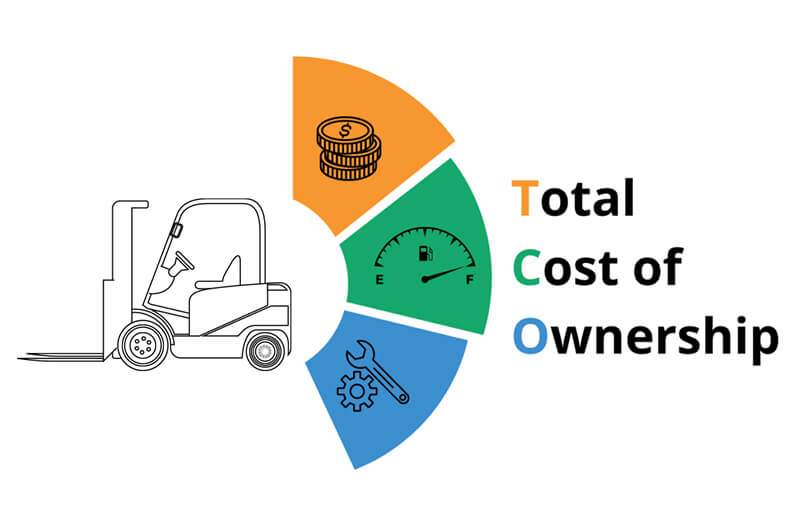
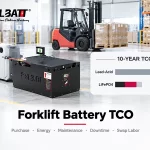
Forklift battery TCO = purchase price + energy + maintenance + downtime + swap labor + replacement and residual value, all measured over the same service period. In multi-shift operations, purchase price is usually the smallest line — labor, energy losses, and replacement cycles decide the winner.
Focus keyword: forklift battery total cost of ownership | Category: Material Handling | Reading time: ~10 min
Why the Cheapest Battery on the Quote Is Rarely the Cheapest Battery
A lead-acid quotation and a lithium quotation are not comparable documents. One prices a battery; the other prices a battery plus — in most multi-shift fleets — the elimination of a spare battery, a swap routine, a charging room, a water system, and a replacement cycle that arrives years earlier. If you compare sticker prices, you compare one line of a six-line cost structure.
Total cost of ownership (TCO) fixes that by forcing both options onto the same sheet, over the same period, with the same assumptions. This guide gives you the framework, the formula, and an illustrative set of ranges you can replace with your own numbers.
The Five Cost Lines in a Forklift Battery TCO
Every battery cost falls into one of five lines. The discipline that matters most is measuring both chemistries over the same window — typically five to ten years, or whatever matches your truck holding period.
| Cost line | What to measure | Where the data comes from |
|---|
| Capital | Battery sets, chargers, installation, electrical work, handling equipment | Supplier quotations + your facilities team |
| Energy | kWh drawn from the grid, not kWh delivered to the truck | Meter data, BMS telemetry, or nameplate × hours |
| Maintenance | Routine servicing hours, water, cleaning, repairs, contracted service | Maintenance log or vendor contract |
| Downtime & labor | Battery swaps, waiting for a charged battery, unplanned outages, changeover risk | Time study + loaded labor rate |
| Replacement & residual | Sets consumed inside the window, minus scrap or second-life value | Cycle-life rating vs. your actual cycles per year |
The TCO Formula
Keep it to one line so it survives a spreadsheet and a board review:
Annualized TCO = (Capital + Replacements − Residual) ÷ Years + Annual energy + Annual maintenance + Annual labor & downtime
Then compare two options with the same Years value. If you want a payback figure, use the capital delta against measured annual operating savings:
Simple payback (years) = (Lithium capital − Lead-acid capital, including spares and battery-room infrastructure) ÷ Annual operating saving
No universal payback number applies to every fleet — run the formula with your own quotations rather than adopting an industry average.
Worked Example: Illustrative Ranges
Illustration only — every figure below is arithmetic from the stated assumptions, not a benchmark. Replace the assumptions with your own and re-run the table.
| Assumption used in this illustration | Value |
|---|
| Fleet unit | 1 × Class I counterbalanced truck, 2 shifts, 250 operating days/year |
| Useful energy demand | 40 kWh/day (measure yours — do not copy this figure) |
| Electricity tariff | $0.08–0.20/kWh |
| Loaded labor rate | $45/hour |
| Charge efficiency | Lead-acid ~75% vs LiFePO4 ~96% (per BSLBATT TCO overview) |
| Swap practice (lead-acid) | 2 swaps/day × 15–20 minutes |
| Analysis window | 10 years |
| Cost line (10-year, per truck) | Lead-acid — illustrative | LiFePO4 — illustrative | Basis |
|---|
| Energy | $10,700–26,700 | $8,300–20,800 | 40 kWh/day ÷ charge efficiency × 250 days × 10 yrs × tariff band |
| Maintenance | $10,000–22,000 | $0–2,000 | 2–4 h/month watering, equalization, cleaning, terminal repair vs. inspection only |
| Swap / charging labor | $56,000–75,000 | $0–5,000 | 500 swaps/yr × 15–20 min × $45/h vs. plug-in during breaks |
| Downtime & lost throughput | $5,000–25,000 | $0–5,000 | Waiting on a charged battery, outages, spill incidents |
| Battery room, gas extraction, water system | $5,000–15,000 | $0–2,000 | Lead-acid requires dedicated space, ventilation and demineralized water |
| Replacement sets inside the window | $6,000–16,000 | $0 | ~1,000-cycle lead-acid life vs >3,500-cycle LiFePO4 at ~250 cycles/yr |
| Operating subtotal | $93,000–180,000 | $8,000–35,000 | illustrative; add capital from your own quotations |
| Capital (use your quotation) | Initial set + spare set + conventional charger — INPUT | 1 pack + matched CAN charger — INPUT | Price varies by capacity, voltage and region |
The pattern to notice is not the size of any single number — it is the shape. Where a fleet runs multiple shifts, the recurring lines (swap labor, maintenance, replacement) can outweigh the purchase price several times over. Where a fleet runs one light shift on a truck that sits idle half the day, they often do not, and the lithium case gets weaker. That is why the worksheet matters more than the example.
Where Lithium Changes the Math
Each of these drivers moves a specific TCO line. Use the table to find which lines actually apply to your operation — and ignore the ones that don’t.
| Driver | Lead-acid | LiFePO4 | TCO line affected |
|---|
| Charge efficiency | ~75% | ~96% | Energy |
| Charge strategy | 6–8 h full charge plus cool-down; swap required | Opportunity charging during breaks; no removal | Swap labor, downtime |
| Cycle life | ~1,000 cycles | >3,500 cycles | Replacement |
| Usable depth of discharge | Deep cycling shortens service life | Deeper usable DoD without the same penalty | Capital, replacement |
| Routine maintenance | Watering, equalization, cleaning, terminal care | No routine watering; remote monitoring instead | Maintenance |
| Infrastructure | Charging room, gas extraction, water treatment | Charging point on the floor | Capital, facility cost |
| Data visibility | Manual logs | BMS telemetry: SOC, SOH, fault history | Downtime, planning |
Comparative figures above are taken from BSLBATT’s overview Industrial Lithium Batteries: Initial Price vs. Long-Term Costs. Confirm each figure against your own supplier datasheets — actual performance varies with duty cycle, temperature and charging practice.
Hidden Costs Buyers Forget
- Spare battery ratio. Multi-shift lead-acid fleets typically hold more than one battery per truck; that inventory is capital sitting on a rack.
- Battery room footprint. Floor area, racking, ventilation, gas extraction and spill containment are real facility costs with a real square-meter price.
- Water treatment. Lead-acid batteries need demineralized water — plus the labor to top them up and the record-keeping to prove it happened.
- Handling equipment and compliance. Hoists, stands, roller racks, PPE, training, insurance and inspection obligations around acid handling.
- Electrical upgrade and demand charges. Adding fast chargers can push a site into a higher demand band; check the tariff structure, not just the kWh rate.
- Wrong sizing. An undersized pack forces mid-shift interruptions; an oversized one adds capital you never use. Size from measured kWh per shift.
- End-of-life. Lead-acid carries scrap value; lithium residual value depends on second-life and recycling channels in your region. Put a number on both, or leave both out of the comparison — but treat them the same way.
Six-Step Worksheet: Build Your Own TCO
- Fix the window and the scope. Years (5–10 typically), truck count, shifts per day, operating days per year. Both options get identical values.
- Measure energy, don’t estimate it. kWh per truck per shift from BMS telemetry or a clamp meter. This single number drives the energy and sizing lines.
- Price the energy line properly. Grid kWh = useful kWh ÷ charge efficiency. Multiply by your tariff, including demand charges and any night-rate windows.
- Count the labor. Swaps per day × minutes per swap × loaded labor rate × operating days. Add maintenance hours at the same rate.
- Add maintenance and infrastructure. Watering and equalization hours, cleaning, repairs, plus amortized battery-room and water-system cost.
- Close with capital, replacement and residual. Sets consumed = (cycles per year × years) ÷ rated cycle life. Subtract residual value. Then annualize and run the payback formula.
Practical note: whichever supplier you are evaluating should be able to fill rows 2, 3 and 6 with your data. If a proposal only speaks in purchase price, it isn’t a TCO proposal.
When Lithium Does Not Pay Back
Being honest about the boundary cases is what makes the rest credible:
- Single-shift, low-utilization trucks. If one lead-acid battery comfortably covers the shift and swaps are rare, the largest savings line disappears.
- Short holding period. Trucks leased or returned before the payback window closes the case on capital recovery.
- Sunk battery-room infrastructure. If the room, ventilation and water system are already paid for and sized, the facility saving shrinks to maintenance only.
- Backup and seasonal equipment. A truck that runs a few hundred hours a year will not cycle out a lead-acid set inside your window.
- Duty cycles without thermal margin. Extreme ambient conditions need a thermal management conversation before a cost conversation.
What to Ask a Supplier Before You Sign
- Cycle-life definition in writing — cycles to what percentage of original capacity, at what depth of discharge and temperature. Check it against the warranty terms.
- Usable kWh, not nameplate Ah. Ask how much of the rated capacity is actually usable in your duty cycle.
- Round-trip efficiency with a test basis — a percentage with no method behind it is marketing.
- Opportunity-charging limits — maximum charge rate, and what it does to cycle life.
- Charger compatibility — connector, power class and the CAN handshake as a matched pair (see the charger matching guide).
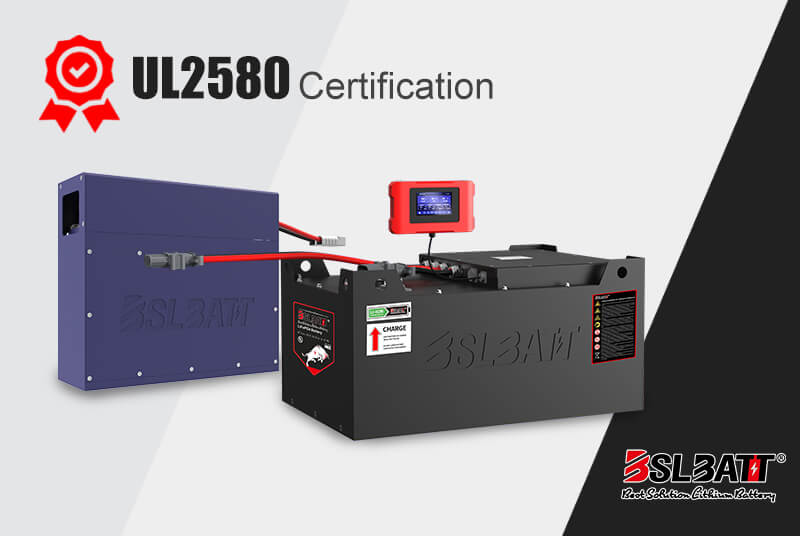
- Certification scope — pack-level certification for industrial vehicles, cell-level transport approval (see the UL 2580 overview).
- Residual capacity guarantee — what capacity is promised at the end of the warranty term.
- Telemetry and data export — whether SOC/SOH and fault history are included or an add-on (architecture explained in the technology overview).
- Installed cost, not pack price — charger, installation, electrical work and commissioning in one quotation.
FAQ
What is forklift battery total cost of ownership?
Forklift battery total cost of ownership is the full cost of powering a truck over a defined period: capital, energy, maintenance, labor and downtime, replacement sets, minus any residual value. It is expressed as an annualized figure so that battery options with different upfront prices and different service lives can be compared fairly.
How do you calculate TCO for a forklift battery?
Annualized TCO equals capital plus replacements minus residual, divided by the analysis years, plus annual energy, maintenance, and labor or downtime cost. Measure kWh per shift, divide by charge efficiency to get grid energy, multiply by your tariff, then add swap and maintenance hours at your loaded labor rate.
Is a lithium forklift battery worth the higher purchase price?
In multi-shift operations it usually is, because lithium removes the recurring lines that dominate lead-acid cost: swap labor, watering and equalization maintenance, battery-room infrastructure, and earlier replacement. In single-shift or low-utilization service, those savings shrink and the payback can outlast your holding period.
What costs do people forget when comparing lead-acid and lithium?
The commonly missed items are spare battery inventory, dedicated charging-room floor area, gas extraction and ventilation, demineralized water systems, battery handling equipment and operator training, electrical upgrades and demand charges, unplanned downtime, and end-of-life scrap or recycling value.
How many years should a forklift battery TCO analysis cover?
Cover a window that matches your truck holding period and the battery’s expected service life — commonly five to ten years. The critical rule is that both options must be measured over the identical window, otherwise a battery that simply lasts longer looks artificially expensive.
Does opportunity charging reduce forklift battery TCO?
Yes, in most multi-shift fleets. Charging during breaks and shift changes removes battery swaps, spare battery inventory and the charging room, which are among the largest recurring cost lines. The pack and charger must be specified as a matched pair for high-rate charging to stay safe and warranty-compliant.
What payback period should I expect on a lithium conversion?
There is no universal figure. Divide the capital difference — including spares and infrastructure you no longer need — by your measured annual operating saving. Fleets with high shift intensity, high labor rates and frequent swaps pay back fastest; single-shift fleets with low utilization pay back slowest.


 Explore all product lines